Helium Leak Testing
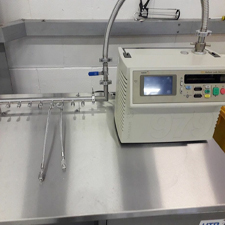
Helium is the best option of tracer gas in finding leaks because of properties like it is non-toxic, inert, non-condensable, non-flammable and is not usually present in the atmosphere in more than trace amounts (5 ppm). Because of the small atomic size of helium, it passes easily through leaks.
Properties of Helium as a Tracer Gas
Due to its unique chemical and physical properties, helium provides the highest sensitivity and reliability in quantitative leak detection.
Non-Toxic
Completely safe for operators, clean environments, and sensitive test systems.
Chemically Inert
Does not react with base metals, seals, gaskets, or surrounding atmospheric gases.
Non-Condensable
Maintains gaseous state consistently across vacuum and wide temperature ranges.
Non-Flammable
Zero risk of combustion or fire in industrial and high-temperature testing environments.
Trace Atmospheric (5 ppm)
Minimal background presence in air ensures exceptional signal-to-noise ratio and zero false positives.
Small Atomic Size
Passes easily through micro-fissures and ultra-tight leak paths for unmatched leak sensitivity.
Mass Spectrometer Leak Detector (MSLD)
A Helium Leak detector which is also called as a Mass Spectrometer Leak Detector (MSLD), is used for locating and measuring the size of leaks into or out of a system or containing device.
MSLD Detection Principle & Sequence
Quantitative Partial Pressure AnalysisThe tracer gas is introduced to a test part that is connected to the leak detector. The helium that is leaking through the test part gets entered through the system. The partial pressure is measured and the results are displayed on a meter.
Gas Introduction
Helium tracer gas is applied to the test part connected to the MSLD system.
Leak Ingress
Helium migrating through microscopic leak paths enters the sensing analyzer.
Partial Pressure
The spectrometer ionizes helium atoms and measures partial pressure precisely.
Meter Readout
Quantitative leak rate values are displayed instantaneously on a calibrated meter.