Ultrasonic Testing
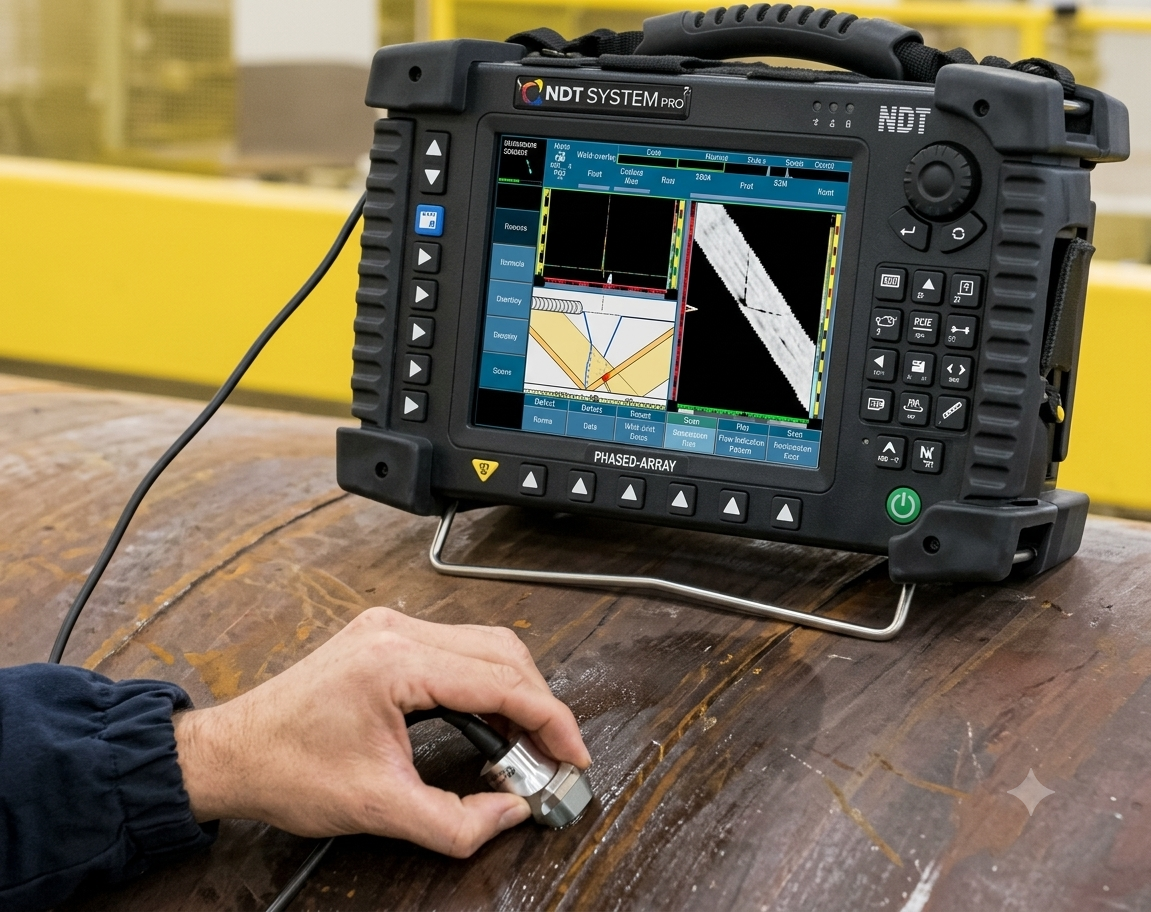
Ultrasonic Testing is family of Non Destructive Testing Techniques best on the propagation of ultrasonic waves in the object or material tested. There are two methods of receiving the ultrasound waveform, reflection and attenuation.
Ultrasonic Waveform Receiving Methods
Reflection Mode
Pulse-Echo ModeIn reflection (or pulse-echo) mode, the transducer performs both the sending and the receiving of the pulsed waves as the “sound” is reflected back to the device. Reflected ultrasound comes from an interface, such as the back wall of the object or from an imperfection within the object.
The diagnostic machine displays these results in the form of a signal with an amplitude representing the intensity of the reflection and the distance, representing the arrival time of the reflection.
- Single/dual transducer emits and receives pulsed waves
- Reflections originate from back walls or imperfections
- Signal amplitude indicates intensity; arrival time indicates depth
Attenuation Mode
Through-TransmissionIn attenuation (or through-transmission) mode, a transmitter sends ultrasound through one surface, and a separate receiver detects the amount that has reached it on another surface after traveling through the medium.
Imperfections or other conditions in the space between the transmitter and receiver reduce the amount of sound transmitted, thus revealing their presence.
- Transmitter sends sound; separate receiver detects transmitted energy
- Internal defects reduce transmitted signal volume
- Reveals internal voids, laminations, and structural flaws
Role of Couplant in Ultrasonic Testing
Using the Couplant increases the efficiency of the process by reducing the losses in the ultrasonic wave energy due to separation between the surfaces.
More about service
Leverage the information box style to display your information in the accordion style.