Tensile Testing
Test Name: Testing on Universal Testing Machines
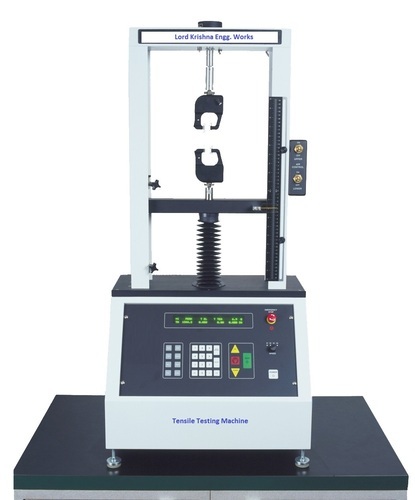
About the test: Tensile Test on:
With Yield Stress, UTS, %Elongation, Stress Strain Graph, Young’s Modulus, Proof Stress at 0.1%, 0.2% & so on. This test is widely used to determine strength, ductility, resilience, toughness and several other material properties.
Specimen Preparation & Method
A test specimen of circular, square or rectangular cross-section of a suitable size is prepared from the material to be tested. The specimen is held by suitable means between the two heads of a testing machine and subjected to a progressively increasing tensile load till it fractures. A record of load acting on the specimen with progressive extension of the specimen is obtained.
Key Material Properties Evaluated
During tensile testing on the Universal Testing Machine, the following critical mechanical properties and technical parameters are measured and reported:
Ultimate Tensile Stress (U.T.S.)
It is the highest value of the stress that the material can bear or sustain without fracture.
Breaking Stress or Fracture Stress
It is the stress value at the point of fracture or failure.
Yield Stress
It is the stress at which the material yields i.e. shows appreciable plastic deformation at almost constant stress without any strain hardening. This stress exists in some materials like low carbon steels and mild steel.
Proof Stress
Proof Stress is reported for those materials which do not show yield point or well defined straight line portion on their stress strain diagrams and is an equivalent term to the yield stress or elastic limit stress. Proof stress is defined as the stress at which the material shows a specific amount of plastic deformation or permanent set. This specified amount of plastic deformation is of the same order as that observed during yielding of the materials which show yield point and is between 0.1 and 1.0 percent. If nothing is specified. It is customary to evaluate the proof stress at 0.2% permanent deformation.
Ductility
It is the ability of the material to exhibit large plastic deformation prior to fracture under tensile loading conditions. It is also defined as the ability of a material to be drawn into five wires. Ductility is expressed by percent elongation.
Malleability
It is the ability of a material to exhibit large plastic deformation prior to fracture under compressive loading conditions. It is also defined at the ability of a material to be rolled into thin sheets. Since the test is tensile, malleability of a material cannot be accurately determined from this test. However, an approximate idea about malleability can be obtained from % reduction in cross-sectional area of the specimen.